
They Said It Was Impossible: Connecting a Legacy Alarm Panel to VoIP
I have always believed that you should be very careful before declaring something impossible. Not because everything is possible, but because there is an enormous difference between something that cannot be done and something we have not yet figured out how to do.
Sometimes we inherit a method that has worked for 30 years. We learn it, maintain it, and eventually accept it as the only way. Then someone asks whether there is another approach, and the answer comes back almost immediately: “No. That system does not work that way.”
But why not?
That question is where engineering becomes interesting. Progress often begins with curiosity, a few unsuccessful attempts, a willingness to challenge your own assumptions, and the patience to find out exactly where two technologies stop understanding each other.
I recently encountered a perfect example while working to integrate an aging security monitoring panel with a modern cloud VoIP service. The system was designed for an analog telephone line. Its manufacturer support had reportedly ended years ago. Experienced technicians familiar with the equipment told us that integrating it with VoIP simply could not be done.
We eventually made it work, and the monitoring centre confirmed a successful alarm transmission.
This is the story of how we got there, what actually prevented the system from communicating, and what the experience taught me about bringing legacy technology into the modern world.
1. First, What Exactly Is an ATA?
An Analog Telephone Adapter, or ATA, is a device that allows traditional analog telephone equipment to connect to a Voice over Internet Protocol network.
Think of an old telephone, a fax machine, or an analog communicator that expects an ordinary telephone line. It does not speak SIP, the signalling protocol used by many modern VoIP platforms. It expects telephone line voltage, dial tone, and familiar analog behaviours.
An ATA provides that analog interface through an FXS port, then converts the call into traffic that can travel through a VoIP service. It is, in simple terms, a translator between an older telephone interface and a modern communications network.
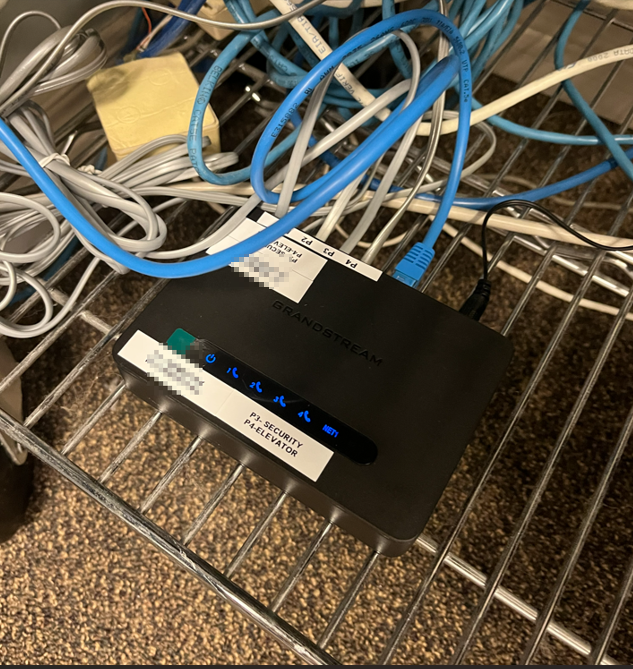
The Grandstream HT814 ATA used for the legacy security communicator.
For ordinary voice calls, this translation is often straightforward. For equipment that sends alarm information through carefully timed audio tones, the details matter a great deal more.
2. The Old Telephone Network Versus VoIP
Traditional alarm communicators were designed around the Public Switched Telephone Network, or PSTN. The panel connects to an analog telephone line, dials a receiver at the monitoring station, and exchanges signalling using sounds carried through the telephone connection.
With VoIP, part of that journey changes. An ATA creates the local analog interface, but the call is then carried across an IP network using protocols and audio handling methods that were not necessarily designed with decades old alarm communicators in mind.
That introduces opportunities for problems. A call may connect while audio processing changes the timing or shape of the tones being transmitted. A service may use a DTMF handling method that works beautifully for selecting an option on a phone menu but is unsuitable for a legacy communicator sending alarm data.
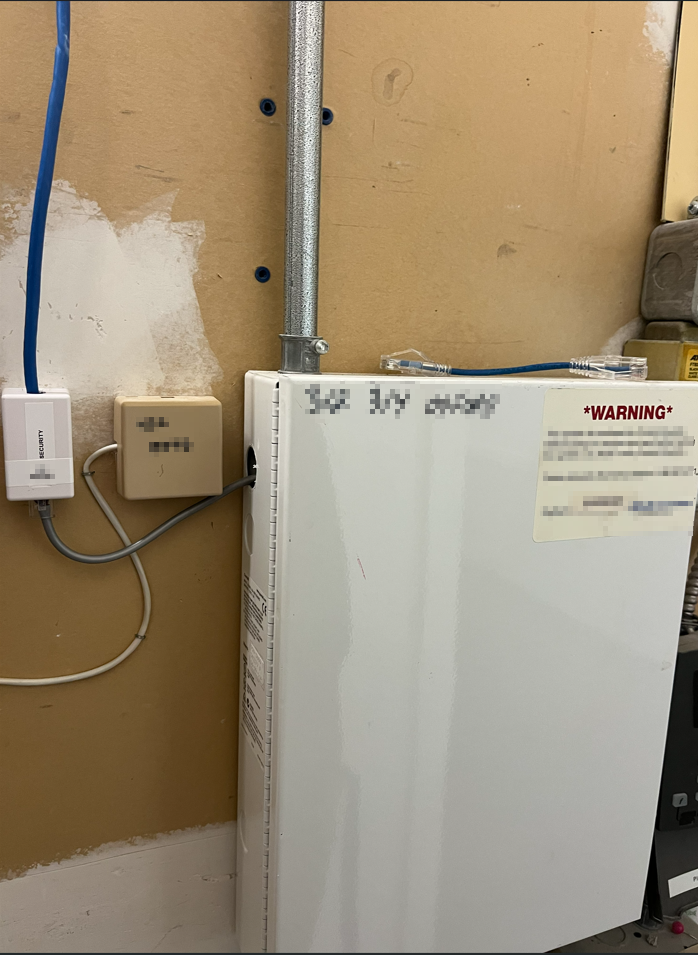
What A monitoting Panel looks like.
The important distinction is that a successful VoIP call does not automatically mean a successful alarm transmission.
3. How Does a Legacy Alarm Panel Report an Event?
Many older security alarm systems use a signalling format called Contact ID. It allows a control panel to report events such as an alarm, a trouble condition, or a restoration to a compatible monitoring receiver.
In a traditional Contact ID exchange, the panel dials the receiver, listens for the expected handshake, and sends a structured series of DTMF tones. The receiver interprets those tones as an event message and responds with an acknowledgement if the transmission is accepted.
This is not a person speaking on a telephone. It is one machine communicating with another through precisely interpreted tones.
And that leads to an idea I love about networking.
At its core, digital information can be represented as ones and zeros. But communication is not simply about moving bits from one place to another. Both ends must agree on what those bits, signals, timings, and messages mean. Two systems do not have to be built in the same decade or use the same underlying network. They need a compatible way to communicate, or an intermediary capable of preserving the information between them.
The real challenge is not whether the technologies are old or new. It is whether the message can survive the journey and still be understood.
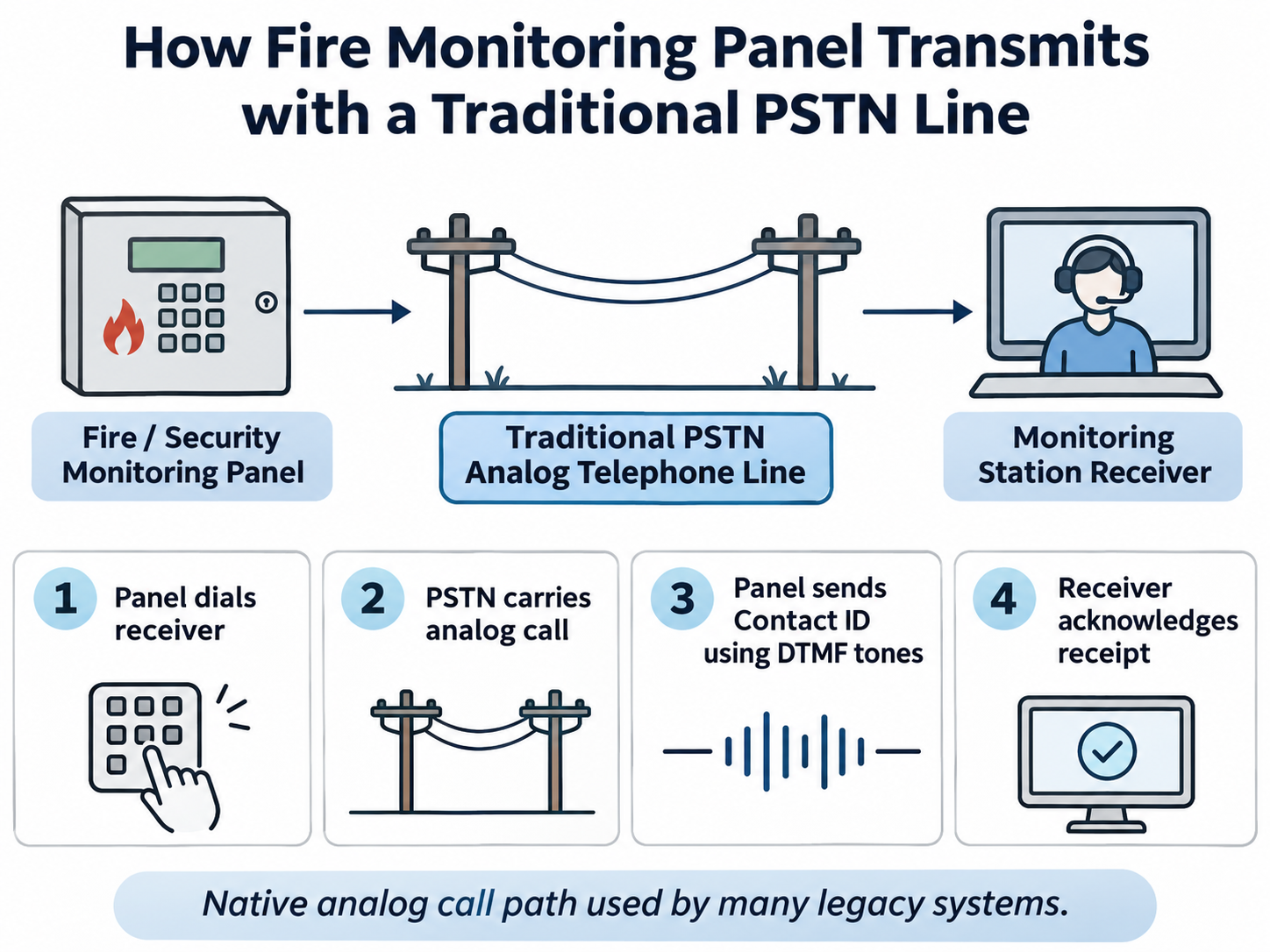
Contact ID reporting uses receiver handshake, DTMF event tones, and an acknowledgement.
4. The Legacy System Everyone Said Would Not Work
The equipment at the centre of this project had been operating in the era of traditional analog telephone communications. Replacing the entire security system was not the objective. We wanted to understand whether its existing communicator could reliably exchange alarm information over a modern VoIP service.
Here was the equipment and communications environment:
Main Control Board: 641-3600 Rev. 8
Communicator Module: 650-3633P
Support Status: Legacy system, reportedly unsupported since 2015
Original Communications: Analog telephone line
Alarm Reporting Protocol: Contact ID
VoIP Service Provider: 8x8
Analog Telephone Adapter: Grandstream HT814
ATA Connection: FXS Port 3
The technicians' concern was understandable. Some alarm communicators are extremely sensitive to changes in telephone line behaviour, and not every VoIP service can reproduce the conditions they require. In many installations, a modern approved communicator or another supported transmission path is the correct solution.
But I wanted to answer a more specific question: Was this particular panel fundamentally incapable of working through an ATA, or had we simply not found the correct conditions for it to communicate?
5. The First Failure: The Panel Could Not See Its Telephone Line
Our initial testing produced two familiar but frustrating conditions:
Land Line Trouble Supervisory.
Communication Trouble.
These messages sound similar, but they point to different parts of the problem. The first indicated that the panel was not satisfied with the telephone line condition. The second indicated that it had not successfully completed its required communication with the monitoring receiver.
That distinction mattered. Instead of treating the whole integration as a single failure, we broke the process into stages. Could the panel recognize the analog interface? Could it seize the line and place a call? Could it exchange signals with the receiver? Could the receiver actually decode and accept the alarm message?
We reviewed the ATA settings, the 8x8 configuration, and how the analog communicator interacted with the emulated telephone line. We also investigated whether the issue might involve the FXS line characteristics and regional SLIC settings.
One important change was removing SRTP from the relevant voice configuration. SRTP encrypts media carried over a VoIP connection, and its use or negotiation must be compatible with the service and endpoints involved. In our tested environment, the configuration changes around SRTP were followed by a meaningful result.
The monitoring side reported that the landline condition had been restored.
That was our first breakthrough. The panel now recognized an acceptable telephone line condition.
But we were not finished.
6. The Second Failure: The Call Worked, but the Alarm Message Did Not
At this point the situation became even more interesting. We had moved beyond the original line supervision failure, yet attempts to send an alarm event still resulted in communication trouble.
The panel could use the line, but the receiver was not successfully accepting the Contact ID message.
This is where many integrations are prematurely declared impossible. The connection appears to work, the call is established, and yet the monitoring station receives nothing useful. It is tempting to blame the age of the panel and move on.
Instead, we focused on what was actually travelling across the call: DTMF tones carrying Contact ID data.
VoIP systems can handle DTMF in several ways. Some detect keypress tones and transmit them as separate RTP events, commonly called RFC 2833 or RFC 4733 telephone events. Others use SIP signalling. Another method preserves the tones directly in the audio stream, commonly called in audio or in band DTMF.
Those approaches are not interchangeable for every application. Contact ID depends on the monitoring receiver hearing and interpreting the expected tone sequence. A method optimized for modern telephone keypad events can interfere with a legacy alarm communicator's signalling.
We examined the DTMF settings alongside the audio codec configuration, including the importance of an uncompressed G.711 audio path when transmitting tones. We were not trying to make a phone menu respond to a keypad. We were trying to preserve a machine generated alarm message end to end.
Changing the DTMF handling was the decisive breakthrough in our testing.
The Contact ID transmission succeeded, and the monitoring company confirmed that it had received the test event.
After all the warnings that it would never communicate over VoIP, there it was: a legacy analog alarm communicator successfully reporting through a Grandstream ATA and an 8x8 service.
7. What Actually Made the Difference?
There was no magical setting that makes every old alarm panel work over VoIP. We succeeded by recognizing that the problem contained several different layers, each with its own requirements.
First, the analog interface had to be acceptable to the panel. An ATA does more than provide a telephone socket. It simulates the basic electrical and call behaviours expected by connected analog equipment.
Second, the VoIP call had to establish a usable media path. The endpoint configuration, service provisioning, and media security settings all had to be compatible. In our case, changes to the SRTP configuration were part of resolving the initial problem.
Third, the Contact ID tones had to survive the journey. That meant paying attention to how DTMF was handled and how the audio stream was encoded. This was the key to restoring successful alarm message transmission.
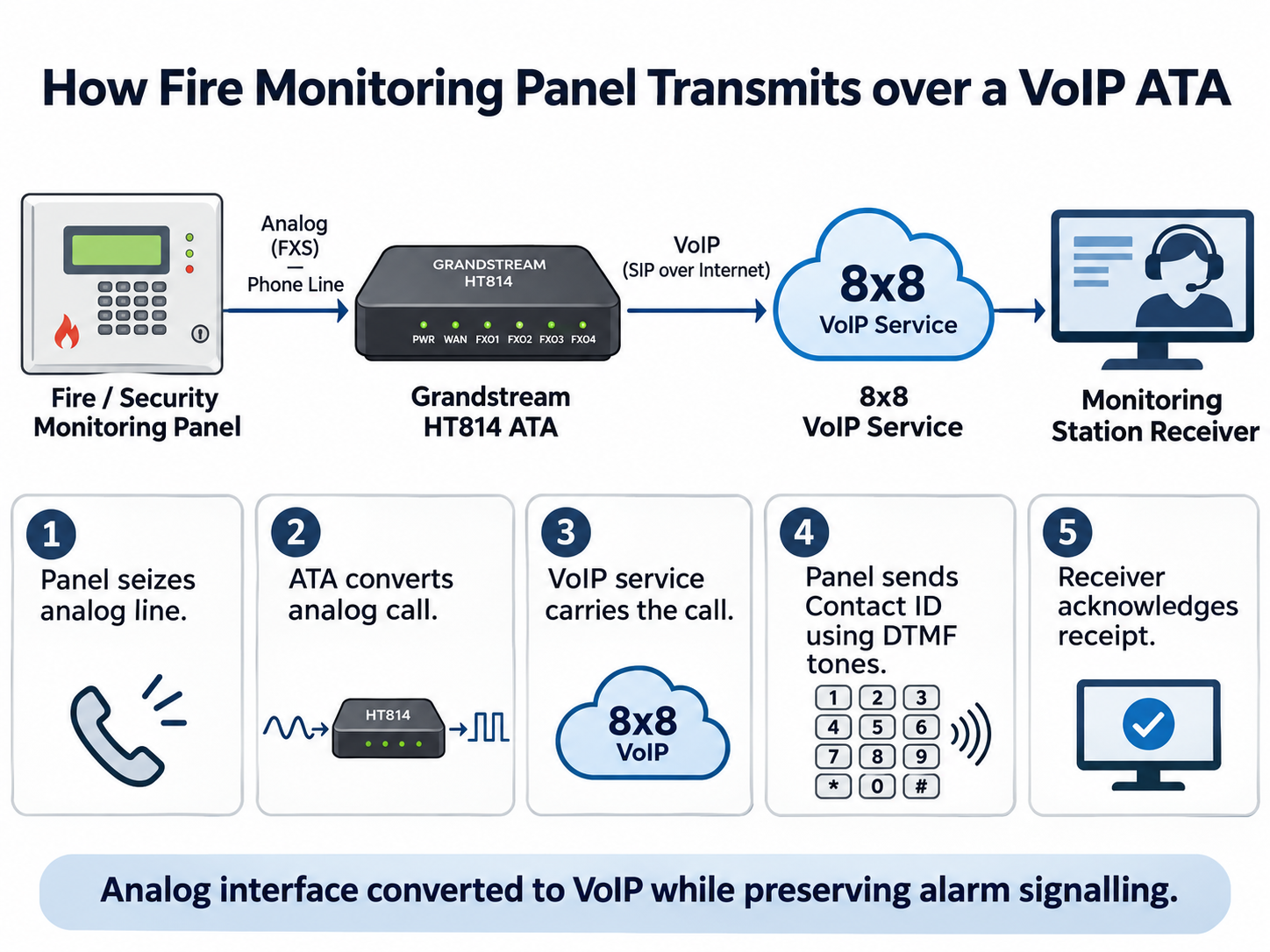
The communication path used to connect the legacy alarm communicator to the monitoring receiver.
The engineering lesson was simple: line detection, call establishment, and successful alarm reporting are three different things. Each has to be verified independently.
For organizations modernizing telephone, paging, security, and other analog communications infrastructure, this kind of systems thinking is central to the work we do at Vekta IT.
8. Getting It Working Is Not the Same as Making It Production Ready
We also uncovered an operational problem worth mentioning.
The Grandstream HT814 was a shared ATA supporting other analog telephone services. Some of the changes required for the alarm communicator also affected the settings used by those other lines. We were concerned that automatic provisioning from 8x8 could overwrite manually adjusted settings after a reboot or future configuration update.
That is not the kind of dependency I want to leave hidden inside a production communications system.
Our proposed next step was to isolate the security communicator on its own dedicated ATA so that its settings could be managed without affecting unrelated voice services. That was an architectural recommendation, not an additional completed migration or a claim of extended field reliability.
There is also an important safety distinction here. A successful Contact ID test proves that a specific message was delivered under the tested conditions. It does not prove permanent reliability, regulatory compliance, or suitability as the sole communications path for a fire alarm system. Fire and life safety applications must follow the applicable codes, monitoring requirements, manufacturer guidance, and approval processes. Where required, use approved alarm transmission equipment and supervised or redundant communication paths.
The achievement in this case was a demonstrated technical integration. Production approval and long term reliability must be evaluated separately.
9. Common Questions About Legacy Alarm Panels and VoIP
Can a legacy alarm panel work with a Grandstream ATA?
Yes, some can. Our tested legacy communicator successfully transmitted a Contact ID event using a Grandstream HT814 and 8x8 VoIP. Compatibility depends on the specific panel, ATA, provider, receiver, and how the signalling is transported. This result should not be treated as a guarantee for every installation.
Why does my alarm panel show Communication Trouble over VoIP?
A panel may be able to dial out while failing to complete the Contact ID exchange. Potential causes include DTMF handling, audio processing, codec selection, packet loss, receiver compatibility, and other call path issues. Test each stage instead of assuming that a connected call means the alarm report was delivered.
What does Land Line Trouble Supervisory mean?
It generally indicates that the panel has detected an unacceptable condition on the telephone line it monitors. The cause can involve the analog interface or line supervision characteristics. It is distinct from a failed attempt to transmit a message to the monitoring station.
Does Contact ID use DTMF?
Yes. Contact ID communicates structured alarm events using DTMF tone sequences together with receiver handshake and acknowledgement signals. Preserving that signalling is essential when routing it across an ATA and VoIP connection.
Is G.711 enough to guarantee Contact ID will work?
No. G.711 can help preserve the audio signal without the distortion introduced by some compressed voice codecs, but it cannot guarantee successful reporting. DTMF handling, packet transport, equipment compatibility, and receiver behaviour still matter.
Can I use a VoIP ATA for a fire alarm monitoring connection?
Do not assume that an ATA is an approved substitute for a required fire alarm transmission method. Fire monitoring requirements vary by jurisdiction, installation, equipment listing, and monitoring arrangement. Consult the responsible alarm service provider and the applicable authority before making changes to a life safety communications path.
10. The Bigger Lesson: Understand the Language Before You Declare Defeat
What stayed with me most about this project was not the equipment or even the successful test. It was how quickly a technical obstacle had been mistaken for a permanent limitation.
The people who warned us about VoIP were not unreasonable. They had years of experience with a system that was never designed around modern SIP networks. Their caution was justified, especially for equipment involved in security and life safety.
But caution and curiosity can exist together.
When a system fails, ask what it is expecting. Ask what the other system is sending. Ask what gets changed in between. Somewhere in that journey, a message may be getting lost, transformed, delayed, or misunderstood. If you can identify that point, you can begin to determine whether a compatible solution exists.
We did not make an old security panel modern by replacing everything around it. We learned how it communicated, identified where the translation was breaking down, and found a way for its message to be understood again.
Never say something is impossible simply because it has never been done that way in your experience. Test the assumption, understand the protocol, respect the safety requirements, and let the evidence tell you what is possible.
At Vekta IT, I bring this same approach to network engineering and communications modernization: understand the existing environment, question unnecessary limitations, and design solutions around how systems actually need to work.