
How to Design Network Infrastructure for Healthcare Facilities: Lessons From Three Major Deployments
Designing network infrastructure for a healthcare facility is a different undertaking from designing a conventional office network. It is not simply a matter of installing switches, deploying wireless access points, and making sure everyone has an Internet connection.
Healthcare environments contain an enormous number of interconnected systems, many of which serve important operational, communications, and resident safety functions. Nurse call systems, wireless medical carts, overhead paging, electronic access controls, surveillance cameras, building automation, and staff communications all have their own infrastructure requirements.
Over the course of my career, I have had the opportunity to engineer core network infrastructure for three newly developed, large-scale healthcare facilities in Ontario, while also supporting enterprise networking across more than 60 healthcare locations operating under a 99.9% uptime Service Level Agreement.
These experiences reinforced an important principle: the challenge is not simply getting everything connected. It is understanding how every system depends on the network, how those dependencies affect one another, and how to maintain reliability once the facility becomes operational.
Here are some of the engineering challenges and lessons I have encountered.
1. The Infrastructure Begins Before the Building Opens
One of the first challenges in a new healthcare facility has nothing to do with switches or wireless access points. It is getting reliable Internet connectivity into the building.
New developments are not always located where enterprise fibre connectivity is readily available. A building may be nearing completion while the nearest suitable carrier infrastructure remains a considerable distance away.
Depending on the location, bringing a dedicated fibre circuit into the facility can involve substantial construction costs, lengthy provisioning timelines, municipal permissions, and coordination between telecommunications providers and construction teams.
This becomes particularly challenging when the building's opening date has already been established.
The network design has to consider carrier availability, the service demarcation point, how connectivity will enter the building, the routing of that connectivity into the main network room, and what alternatives exist if the primary connection is delayed.
It is also important to understand which services depend on external connectivity and which must continue operating locally.
My biggest lesson here is simple: Internet connectivity needs to be part of early construction planning, not something addressed when the network equipment arrives.
2. Physical Cabling Is the Foundation of Everything
Before discussing wireless, firewalls, or advanced routing, the physical network infrastructure has to be right.
A large healthcare facility contains many different types of connected equipment distributed across resident rooms, hallways, nursing stations, administrative offices, mechanical rooms, and common areas.
All of these systems need properly planned connectivity.
The location of the main distribution frame (MDF), intermediate distribution frames (IDFs), fibre backbone, copper cabling, patch panels, and network switches needs to be determined with the actual building layout in mind.
A poorly positioned network closet can create problems with cable distances, infrastructure accessibility, installation costs, and future maintenance.
Physical cabling also requires close coordination with low-voltage contractors. It is important to confirm cable specifications, pathway availability, equipment locations, termination standards, labelling, and testing requirements.
This becomes especially important with technologies such as nurse call, door access systems, cameras, wireless access points, and IP communication endpoints.
Not every system uses the same cable type, power requirements, or communications protocol.
A network design that looks perfect on paper can quickly become difficult to implement if these physical requirements were not considered during construction.
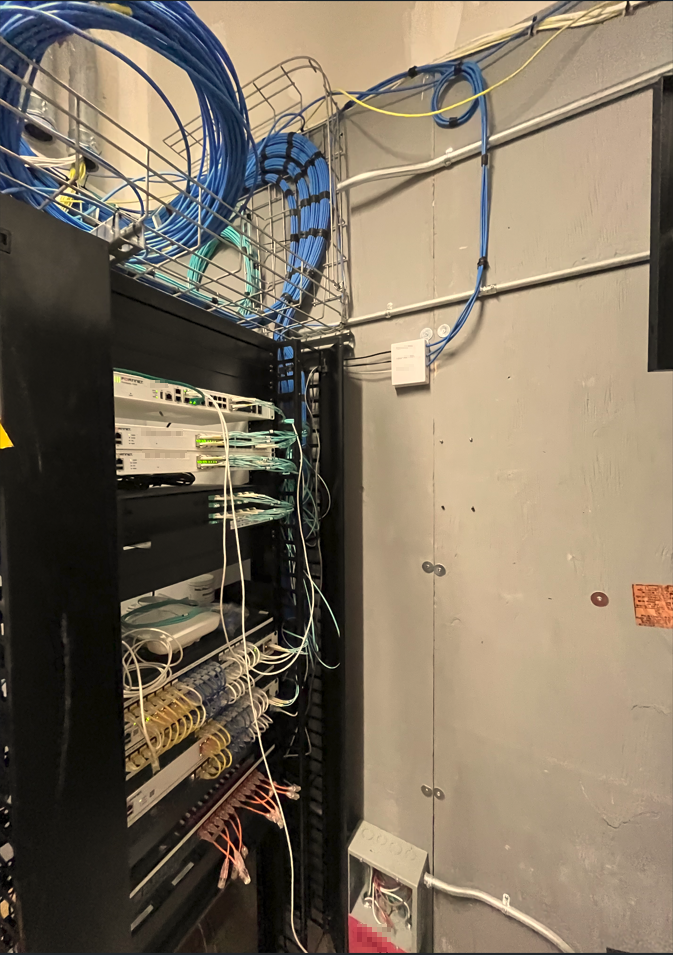 Enterprise campus network architecture and physical infrastructure supporting interconnected facility technologies.
3. Designing the Core Network for Reliability
Once the physical infrastructure has been planned, attention turns to the network architecture itself.
In healthcare, the objective is to create a network foundation capable of supporting multiple independent technologies while reducing unnecessary points of failure.
For large campus environments, I have worked with dual-core network designs using fibre-connected access switching infrastructure.
The goal is to establish a structured and resilient architecture that supports segmentation, predictable traffic flow, and simpler operational management.
Network resilience also goes beyond adding a second core switch.
The design needs to account for uplink paths, hardware dependencies, power availability, firewall connectivity, upstream services, and recovery procedures.
A redundant switching architecture offers limited protection if both paths ultimately depend on a single unprotected power source or another shared point of failure.
This is why I approach network resilience as a complete infrastructure consideration rather than a feature of one device.
4. Nurse Call Integration Is More Complicated Than It Appears
One of the most interesting engineering challenges I encountered was designing how the nurse call infrastructure would integrate with the enterprise network backbone and the facility's cloud-based communications environment.
Nurse call is not simply another application connected to the network.
It is a clinical communications system with important operational dependencies, and its behaviour must be understood before it is integrated with other technologies.
Depending on the system, nurse call infrastructure may involve dedicated controllers, servers, communication gateways, room devices, staff notification systems, and specialized network requirements.
The challenge becomes more interesting when nurse call alerts need to interact with a cloud VoIP platform.
The engineer must consider how alerts leave the nurse call environment, what interfaces the manufacturer supports, how those alerts reach the intended recipients, and what happens if network connectivity or a dependent service becomes unavailable.
My work involved understanding these integration requirements and designing the network connectivity needed to support the relationship between the nurse call infrastructure and modern communications services.
There is an important distinction between a properly engineered integration and simply forwarding an alert to a telephone.
For any life-safety-related functionality, manufacturer requirements, approved integrations, local regulations, and failure behaviour must be validated. Cloud notifications should not be assumed to replace required local nurse call functions.
The lesson is that integration begins with understanding how the clinical system operates, not with configuring the network to pass traffic.
5. Healthcare Wireless Is Designed Around People Who Rarely Stay Still
Wireless is one of the most important components of modern healthcare infrastructure.
Unlike conventional offices, where many employees spend most of their time at fixed workstations, healthcare staff are highly mobile.
Nurses and caregivers move continuously between resident rooms, nursing stations, hallways, treatment areas, and common spaces.
Their devices move with them.
These can include laptops, medication carts, handheld communication devices, and other wireless equipment supporting daily operations.
This creates a different set of wireless design requirements.
The objective is not simply to provide strong signal coverage. It is to maintain predictable connectivity as devices move between access points throughout the facility.
Roaming behaviour, client capabilities, access point placement, network authentication, and wireless performance all become important considerations.
Construction materials also affect wireless propagation. Concrete walls, elevator shafts, fire doors, mechanical equipment, and the physical layout of resident rooms can significantly affect coverage.
One important consideration is that healthcare facilities may also operate specialized wireless systems such as WanderGuard, staff radios, alarms, and medical equipment.
Not all of these technologies operate over Wi-Fi. Some use dedicated radio frequencies or proprietary communications systems.
Understanding which systems operate in which frequency bands is essential when evaluating potential interference and coexistence.
Two devices can be physically close to each other without interfering, while other devices sharing or affecting the same radio spectrum may require much closer investigation.
For these reasons, wireless planning must consider the actual equipment used in the facility rather than assuming that good laptop connectivity means every device will perform reliably.
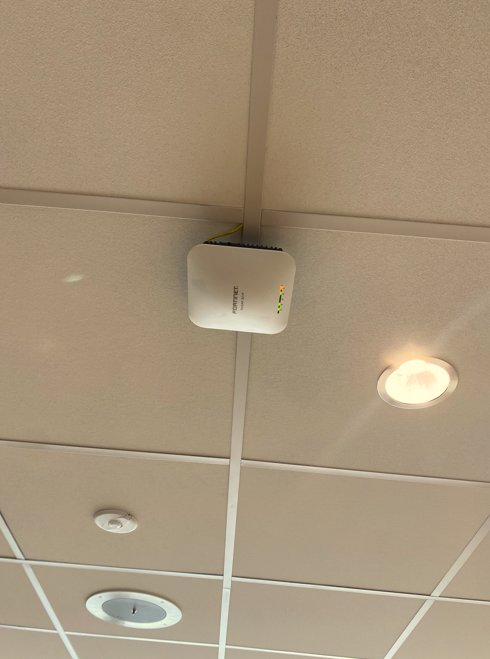 Enterprise wireless access point deployments supporting mobility and reliable connectivity across operational environments.
6. Segmentation and Traffic Prioritization Are Essential
One of the biggest mistakes in enterprise networking is treating all connected devices as if they have the same purpose and operational requirements.
In a healthcare facility, they do not.
A staff laptop, IP telephone, surveillance camera, nurse call controller, building automation device, and access control system have different communication patterns, security requirements, and levels of operational importance.
My network architecture approach incorporates multiple VLANs to logically separate these systems, with firewall policies and network access controls governing permitted communication.
Technologies such as LLDP and LLDP-MED can assist compatible endpoints with network identification and voice VLAN assignment, while Network Access Control (NAC) can provide identity-based or policy-driven access where supported.
The objective is to make the network easier to manage without sacrificing security or flexibility.
Quality of Service is another important consideration.
Not all network traffic has the same tolerance for congestion, packet loss, latency, or jitter.
Voice communications, time-sensitive alerts, and other operational applications may require specific traffic treatment, while general business traffic can often tolerate greater variation in delivery.
I have engineered QoS policies, traffic classifications, and prioritization mechanisms to support predictable application performance.
However, QoS is not simply about marking every important application as high priority. The entire traffic path needs to support the policy, and application requirements must be understood before assigning priorities.
A well-designed healthcare network must balance flexibility, security, and predictable performance across the facility.
7. Vendor Coordination Can Be More Difficult Than the Technology
One lesson that stands out from large healthcare projects is just how many independent contractors and vendors take part in delivering the completed facility.
A single new-build project can involve building automation system vendors, nurse call manufacturers, CCTV integrators, electronic access control specialists, telecommunications providers, cabling contractors, electrical teams, and IT infrastructure engineers.
Each vendor has its own equipment, installation schedule, requirements, and dependencies.
The challenge is that these systems are rarely independent once the facility is operational.
A door controller may require network connectivity to a management server.
A building automation controller may need communication across designated network segments.
A nurse call system may depend on specific network services or supported integrations.
An IP camera requires appropriate switching capacity, PoE, recording infrastructure, and network permissions.
If these requirements are discovered only when the vendor arrives on site to commission their equipment, the project can experience unnecessary delays and expensive rework.
I have found that coordinating these dependencies early is just as important as the network configuration itself.
Equipment inventories, IP addressing requirements, VLAN assignments, cable termination points, firewall communications, vendor access requirements, and commissioning timelines should be established before deployment.
The network team needs visibility into what each vendor is installing and what that equipment expects from the infrastructure.
The engineering challenge is not making every vendor's equipment work independently. It is ensuring that all of their systems work together within one coherent enterprise architecture.
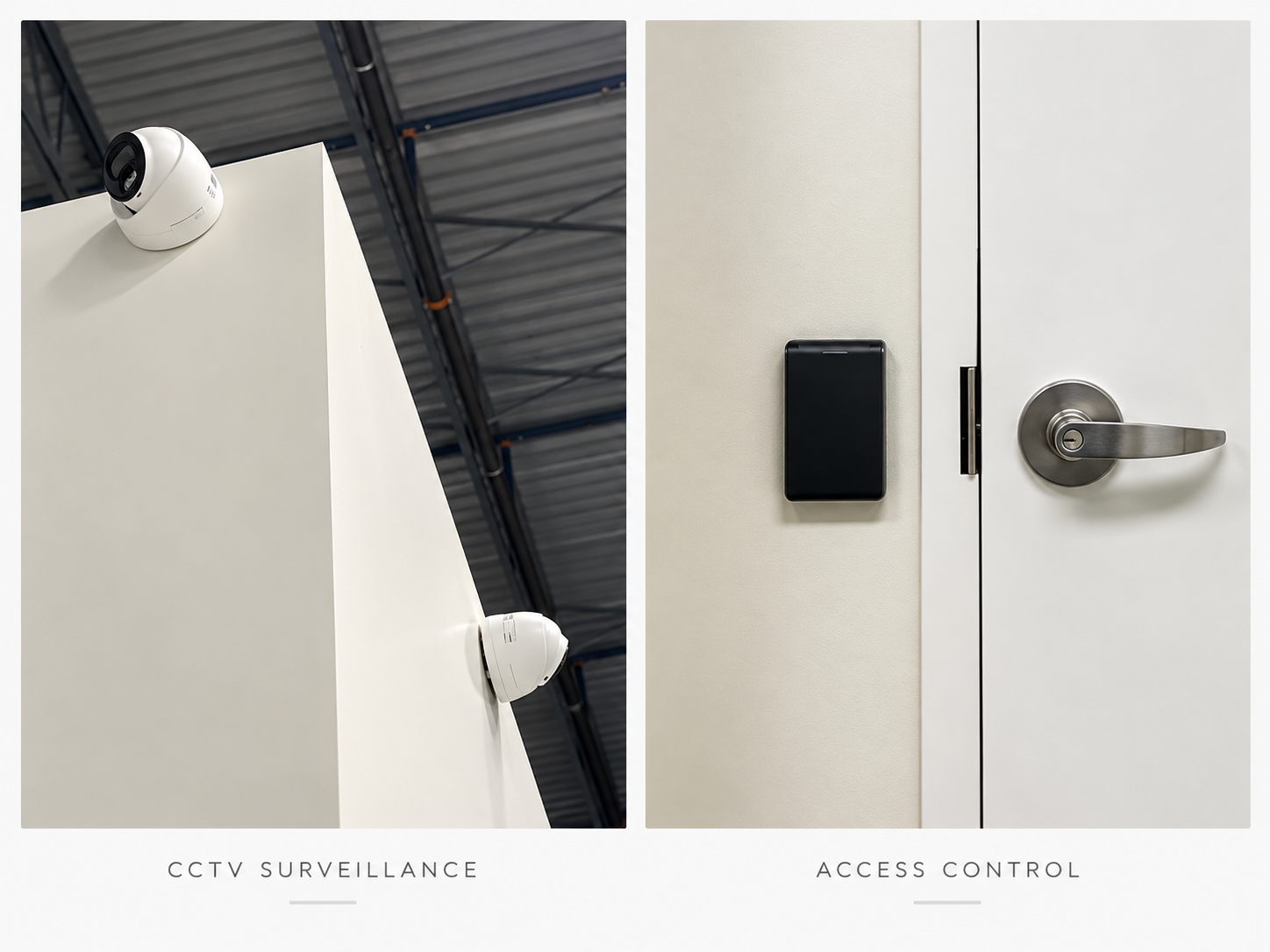 CCTV and electronic access control infrastructure integrated with the enterprise network.
8. Designing Around a 99.9% Uptime SLA
Supporting healthcare infrastructure under a 99.9% uptime SLA changes how you approach network design and operations.
Availability needs to be considered throughout the infrastructure lifecycle.
That means thinking about Internet connectivity, switching resilience, power protection, network monitoring, backup and recovery procedures, firmware maintenance, and the potential consequences of planned changes.
For example, an otherwise healthy network can still experience disruption because of a failed access switch, an exhausted PoE budget, a misconfigured firewall policy, a damaged cable, or a service provider outage.
Strong monitoring and operational procedures help engineers identify these issues before they become prolonged service interruptions.
It is also important to understand that a 99.9% availability objective is not a guarantee that every dependent system will always be operational.
Each system has its own requirements, and meeting an availability target requires measurable service definitions and operational validation.
My experience supporting production healthcare networks has reinforced the importance of standardized configurations, controlled changes, accurate documentation, proactive monitoring, and the ability to troubleshoot problems quickly.
Reliability does not come from purchasing expensive hardware alone. It comes from the quality of the architecture and the discipline used to operate it.
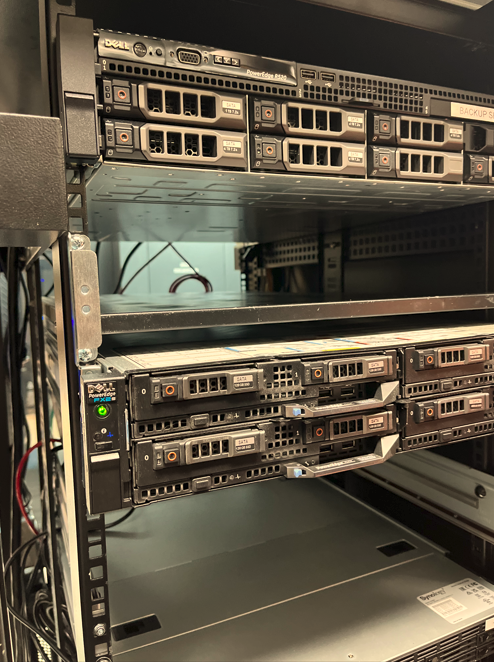 Enterprise connectivity and computing infrastructure supporting distributed organizational operations.
9. What Three Healthcare Infrastructure Deployments Taught Me
Looking back at the experience of engineering infrastructure for three newly developed healthcare facilities, one lesson stands above everything else.
You cannot design healthcare infrastructure one technology at a time.
The network architecture influences communications. Communications depend on network services. Security systems depend on connectivity and access policies. Wireless design depends on mobility requirements. And all of these technologies depend on the physical infrastructure installed during construction.
The earlier these relationships are understood, the easier it becomes to deliver a reliable environment.
I have also learned that some of the most consequential engineering decisions are not necessarily the most technically complicated.
Selecting the right location for a network closet, confirming fibre availability months before construction completes, making sure an access control vendor provides accurate communication requirements, or understanding how nurse call alerts interact with the phone system can make an enormous difference during commissioning.
These decisions may seem minor individually, but together they determine how smoothly the facility transitions from construction into operation.
10. Final Thoughts
Designing network infrastructure for a healthcare facility requires more than strong routing, switching, or wireless engineering skills.
It requires an understanding of the building, the people who will use it, the systems that support its operations, and the consequences of infrastructure failure.
The most successful designs are the ones that account for these relationships from the beginning.
My approach is to treat the network as the foundation connecting the facility's technologies, while making sure each system's security, performance, availability, and operational requirements are properly understood.
After working on three major new healthcare facility deployments and supporting network infrastructure across a large distributed healthcare organization, I have become convinced that the quality of the initial architecture is one of the most important factors in long-term reliability.
A well-designed healthcare network should not need constant intervention to keep functioning. It should provide a stable, secure, and flexible foundation that allows the people operating the facility to concentrate on their work.
That is ultimately what good infrastructure engineering is supposed to accomplish.
I am a network engineer based in Kitchener-Waterloo, Ontario, and I help organizations across Canada plan, build, and support enterprise network and wireless infrastructure, including healthcare facilities. Whether you are planning a new build, modernizing an existing facility, or want a second set of eyes on a design before construction locks it in, see how I can help with your network and Wi-Fi infrastructure.